Friday, October 27, 2023

EOTO Key Post

The Freedmen's Bureau Presentation


My EOTO topic was the freedmen's bureau, this is the script I followed for the presentation:

Hey guys it's Brad, my topic is the Freedmen’s Bureau.


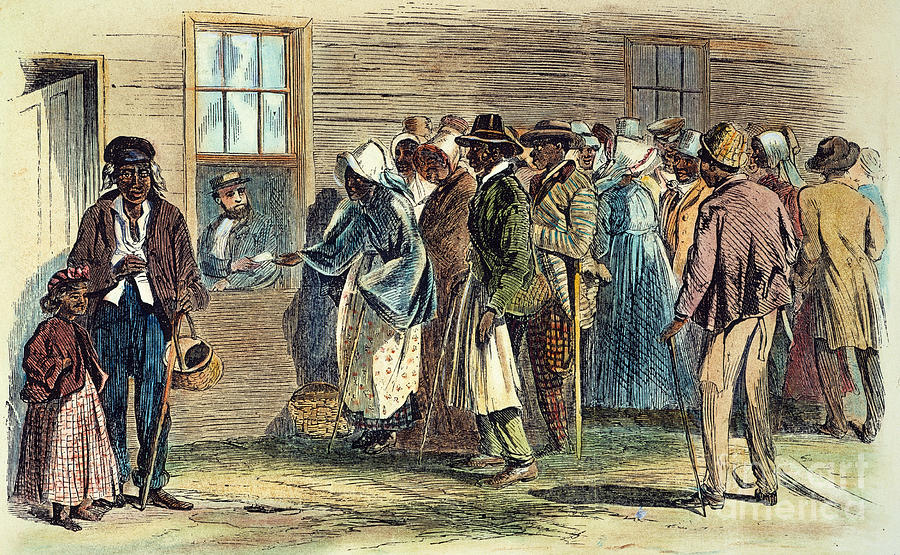
After emancipation the union realized a problem. If they did win the civil war, there would suddenly be 4 million newly freed blacks and displaced whites with little to no possessions or property. To combat this, congress started drafting up the Freedmen’s Bureau. It would be a federal agency that would provide needs to displaced southerners, including freed slaves and poor whites.


It finally became law in 1865 and lasted until 1872. During its 7 years of operation it was able to accomplish quite a bit, despite heavy resistance to it. It existed in these states (show map of states on presentation) and was composed of district commissioners, who oversaw operations in the district, and agents, who actually provided the relief.

The bureau fed millions of people, built hospitals and schools, and even reunited former slaves with family members they were separated from.


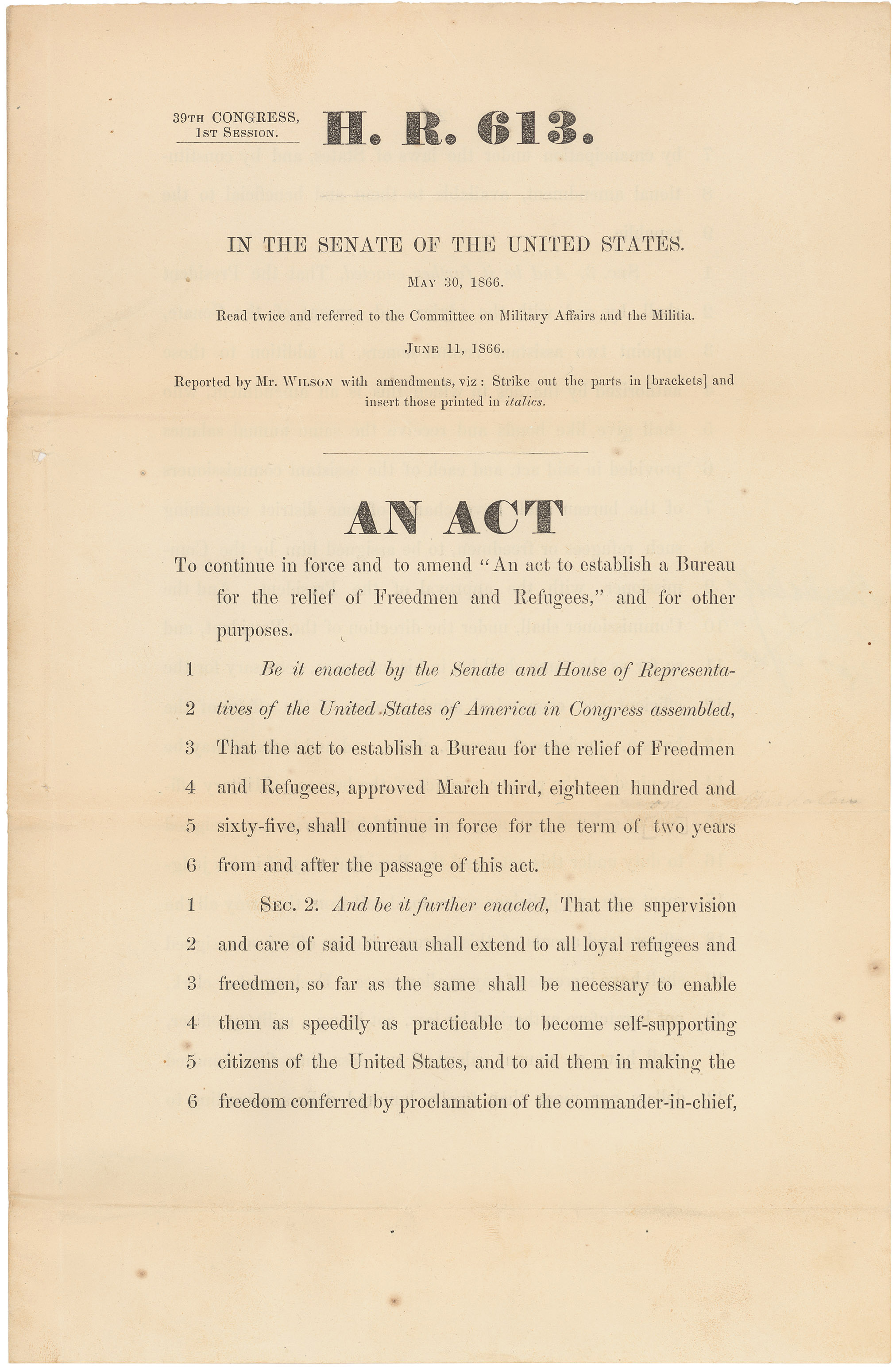
But it wasn’t exactly smooth sailing for the bureau. For one, the original law only allowed the bureau to operate for one year. When that year came and went, congress tried to extend it, and they did! Passing the bill with an overwhelming majority. Now our great president Abraham Lincoln just had to sign it into law, oh wait no he’s dead. Okay well Andrew Johnson will do it, oh wait no he’s racist. So Johnson vetoed the bill, saying it violated “states rights' ”. Fortunately, congress had enough votes to override the veto, but you know what they did? They AGREED with him. A few months later congress came to their senses and passed a new bill extending the duration.


Johnson constantly undermined the bureau’s operations. He would fire bureau agents for being too nice to black people. Yeah. The bureau also tried to take land confiscated from former confederates and redistribute it to the newly freed blacks. In response Johnson gave a presidential pardon to these confederates so they could have the land back. Bureau agents also faced harassment from southerners, including the klu klux klan. The bureau was abolished in 1872 due to pressure from southerners.


Ultimately, the freedmen’s bureau was stifled from achieving its goal. It did as much as it could with its lack of funding and heavy opposition.

Reflection

I am very happy with how this turned out. The goal with my presentations is always to keep the audience engaged and I think I did a good job of that. Admittedly, the freedmen's bureau isn't the most interesting topic of all time, so I didn't have much to work with. One thing I did find interesting though was how congress tried to extend the lifetime of the freedmen's bureau but Johnson vetoed it, and they agreed with him. I found that so bizarre, how they had such a large majority over to pass the bill, (21-9!) yet Johnson was able to change the minds of enough people to have it really be vetoed. Nowadays it seems like congress votes completely on party lines, with disregard for what's actually the right thing to do. I just find it so shocking that congress was able to look at the issue with an open mind and actually decide to change their decision, especially in such a divisive era. Of course In my presentation I didn't say any of this, just showed a cute animation of the wacky antics going on between congress and the president. 
Johnson definitely was the most interesting part about the story of the freedmen's bureau to me, through its lifetime he did everything in his power to discredit the bureau, like firing agents and restoring land to former confederates. Nowadays historians look back on the freedmen's bureau and question its effectiveness, I wonder what its legacy could've been had it not been opposed so hard by Johnson. Another thing I found interesting but didn't mention in my speaker notes, (I think I did actually mention this in my presentation, just not the speaker notes) was that the freedmen's bureau kept numerous records of poor whites and former slaves at the time, and today those records are an invaluable asset for historians. It's good to know that the bureau had this undeniable positive impact on history even if it wasn't able to achieve everything it was created to do.


Sources I used for my presentation:

Mock Trial #2 Reflection

 Mock Trial #2 Reflection

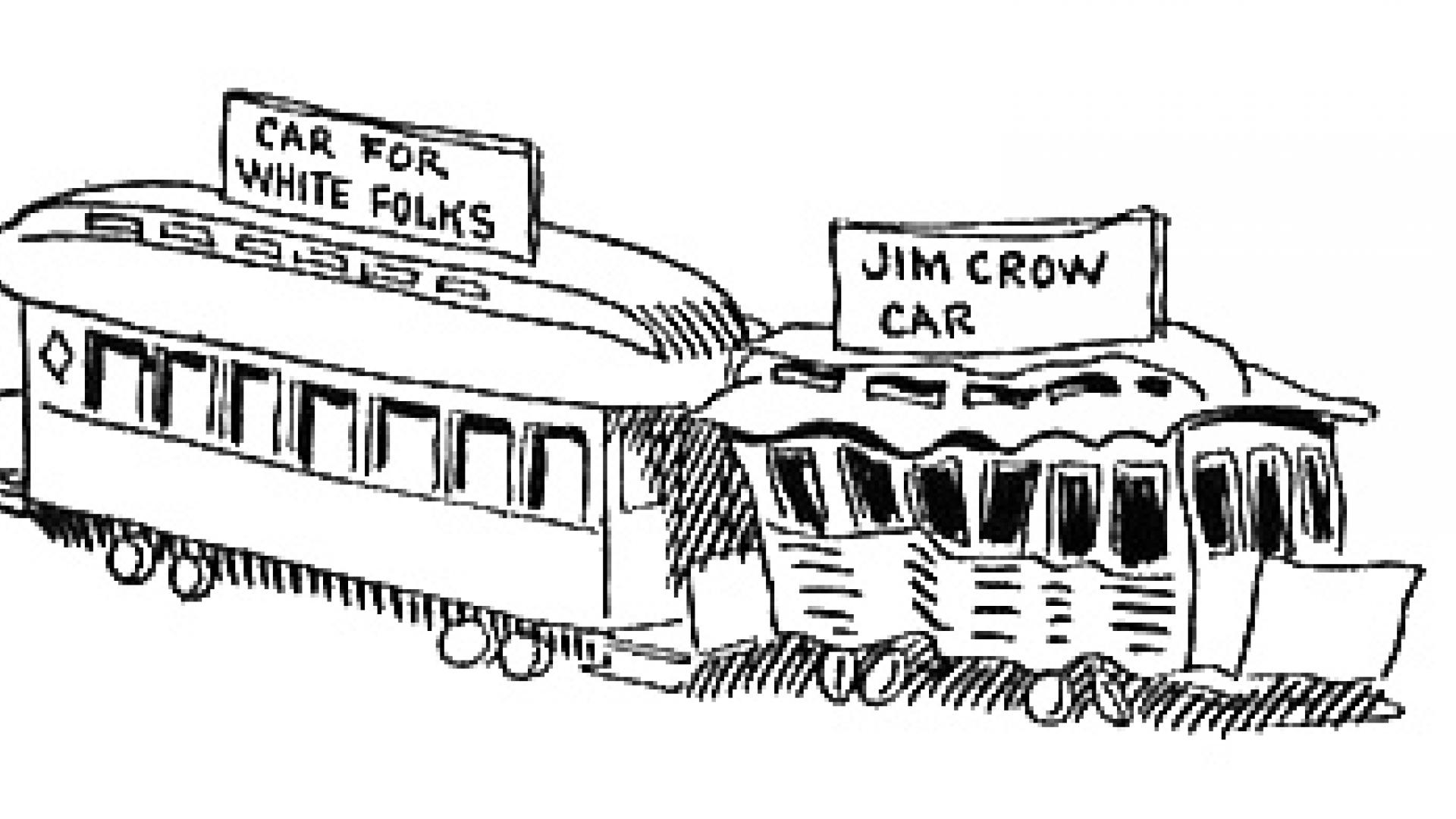
This mock trial was on the case of Plessy v. Ferguson. Homer Plessy was a man who was one eighths black. Concerned with how the U.S. seemed to be regressing laws designed to protect African Americans, Plessy agreed to test the strength of the fourteenth amendment by purposely buying a ticket for a white train car and attempting to sit on it. The police were notified and Plessy was arrested and found guilty. He appealed the case and it went all the way up to the supreme court. Ferguson in this case is the railroad company from which Plessy bought a white ticket.

Arguments in favor of Plessy

There were strong arguments from both sides of this trial, but a few in particular stood out to me. One argument I found very interesting is that there's nothing wrong with Plessy entering this train car. People got upset about it because of an idea in their head that it shouldn't happen, if not for this idea, nobody would have a problem with it. Nobody would've been hurt if everyone just let go of their prejudices. This is racism in a nutshell basically. It's sad that people have predisposed ideas about race that are so strong that they get legitimately upset at something like this, there's just no reason for it. One simple but effective argument in favor of Plessy is that segregation is just bad for business. Operating both a black and white train cars doubles expenses. I liked how straight and to the point this argument was, it's very strong in its simplicity. The last argument I want to touch on is the legal argument, a bit that particular stood out to me is that equality is not a complicated or ambiguous idea. The segregation of the train cars is clearly unequal and should be unconstitutional by the fourteenth amendment. Another argument that's strong in its simplicity, I really liked how it was pointed out how simple of a concept equality is and how this clearly violates it.


Arguments in favor of Ferguson

Overall I think the pro Plessy side had stronger arguments, but there is still some arguments worth noting on the pro Ferguson side. By far the strongest argument on this side was that Plessy's actions were deliberate breaking of the law. It wasn't an accident or a misunderstanding. Plessy had full intention to do what he did and he knew exactly what he was doing. In a court of law this argument is very strong since it focuses entirely on the law being broken. Of course in most other forms of debate this argument is pretty flimsy because we know that just because Plessy was breaking the law, that doesn't necessarily mean he was in the wrong. Still an extremely solid argument from the Ferguson side. The last argument I want to mention is the one about the reasoning behind segregation. People at the time believed segregation was the only way to have a peaceful society at the time. This is interesting to me because it truly is the state of mind people were in at the time. It circles back to the previously mentioned pro Plessy argument about racism being a concept completely created in ones mind, the fact that it was so strong that people believed separation was the only way to keep the peace is sad to think about. Humans can get very attached to ideas sometimes and my takeaway is to be more open minded to other perspectives.

Sources:

https://www.history.com/topics/black-history/plessy-v-ferguson

Images:

https://amsouth.unc.edu/sites/default/files/styles/lesson_plan_banner/public/JimCrowCar2.jpg?itok=mBLGD-lC

Reconstruction Video PBS

 Reconstruction: America After The Civil War Reflection


It's easy to see racism as an idea of the past, and in many ways it is. Truthfully, right now is the best time its ever been to be not white in the United States. We no longer have institutions like slavery and segregation. This does not mean that the situation is perfect however, far from it. The rampant racism prevalent in the reconstruction era still has echoes that can be seen today. The PBS documentary, "Reconstruction: America After The Civil War," gives an in depth look on this. The film starts with a stark reminder of the racism still prevalent today: the 2015 Charleston church shooting. This attack was deliberately targeted towards African American individuals. This hatred is, unfortunately, deep rooted in American Culture.

The meat of the documentary takes place in the decades following the end of the civil war, otherwise known as the reconstruction era. It paints a promising picture for the future of African Americans in the United States, with newly freed slaves getting right to work rebuilding their separated family and participating in society by doing such things as building homes and starting businesses. Unfortunately, this newfound progress would quickly slow, as Abraham Lincoln was assassinated and his vice president, Andrew Johnson, assumed the position of president. Johnson actively stood in the way of African American progress, devaluing the cause.

African Americans had to fight tooth and nail to achieve basic human rights, and even then those newfound rights were constantly being undermined. A supreme court decision could quickly erase years of progress, as happened with the numerous fourteenth amendment decisions. Reconstruction was the start of black culture in the United States, and this documentary describes how this era shaped the culture all the way up to today. But on the other side of the coin, racist and backwards ideas can be passed down from generation to generation. Racism is no longer socially acceptable but it still very much exists because of this generational trickle and we unfortunately saw it in full effect in the 2015 church shooting. This documentary shows how important the reconstruction era was, even how it continues to influence modern society.

Sources:

https://www.scetv.org/stories/2019/reconstruction-america-after-civil-war-premieres-tuesdays-april-9-16-2019-pbs

https://journalofthecivilwarera.org/2019/04/facing-the-false-picture-of-facts-episodes-1-and-2-of-reconstruction-america-after-the-civil-war/#:~:text=Episode%20one%20tells%20the%20story,attempting%20to%20curb%20racial%20violence.

https://www.history.com/this-day-in-history/charleston-ame-church-shooting

Images:

https://d1qbemlbhjecig.cloudfront.net/prod/filer_public/reconstruction-bento-test-pbs/dcd831e71c_Reconstruction-title-cropped.jpg

Sunday, October 22, 2023

Gone With The Wind Reflection


Gone With The Wind Reflection

Note: This is a reflection on the first half of Gone With The Wind, as we didn't watch the second half.

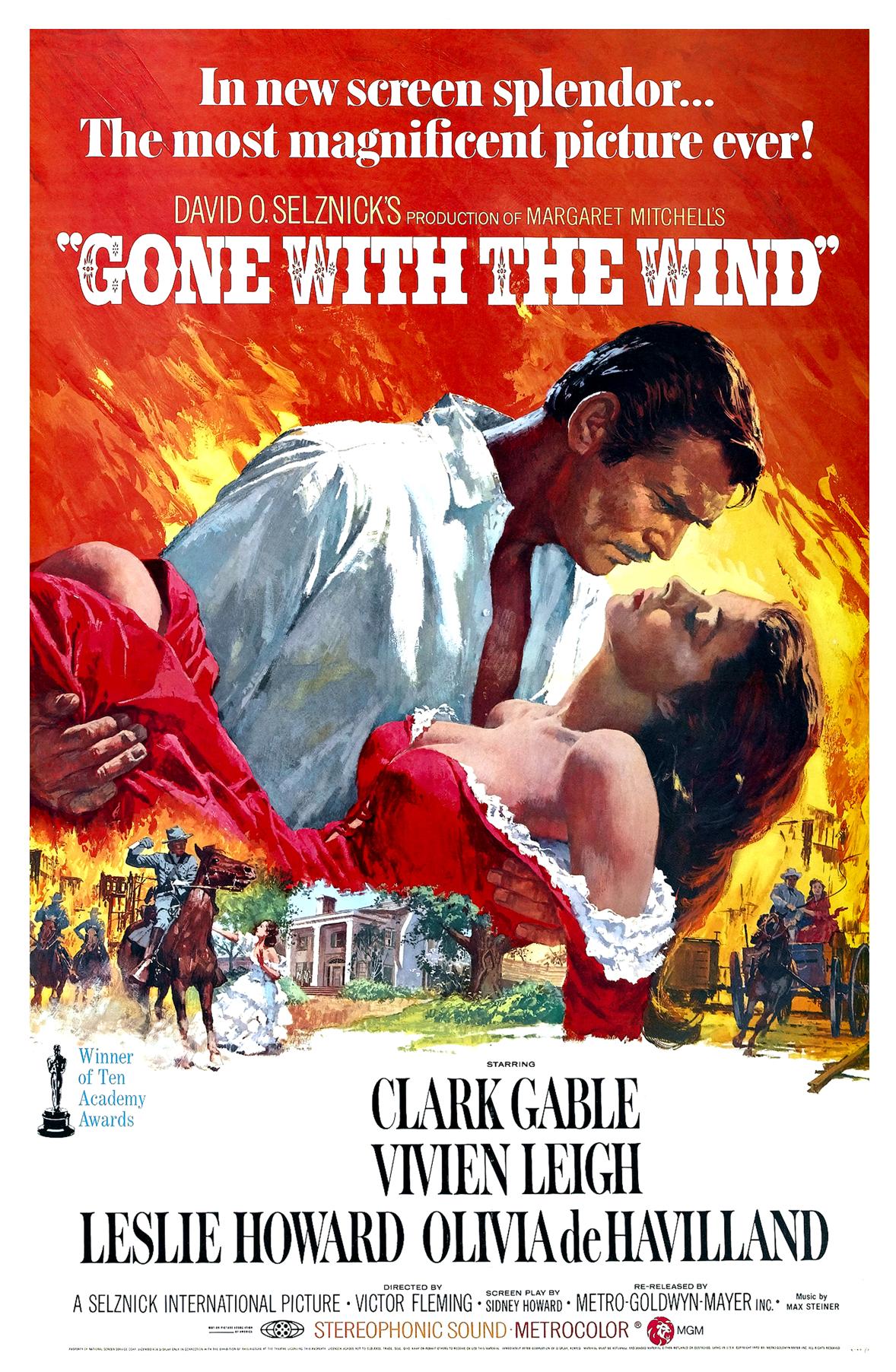
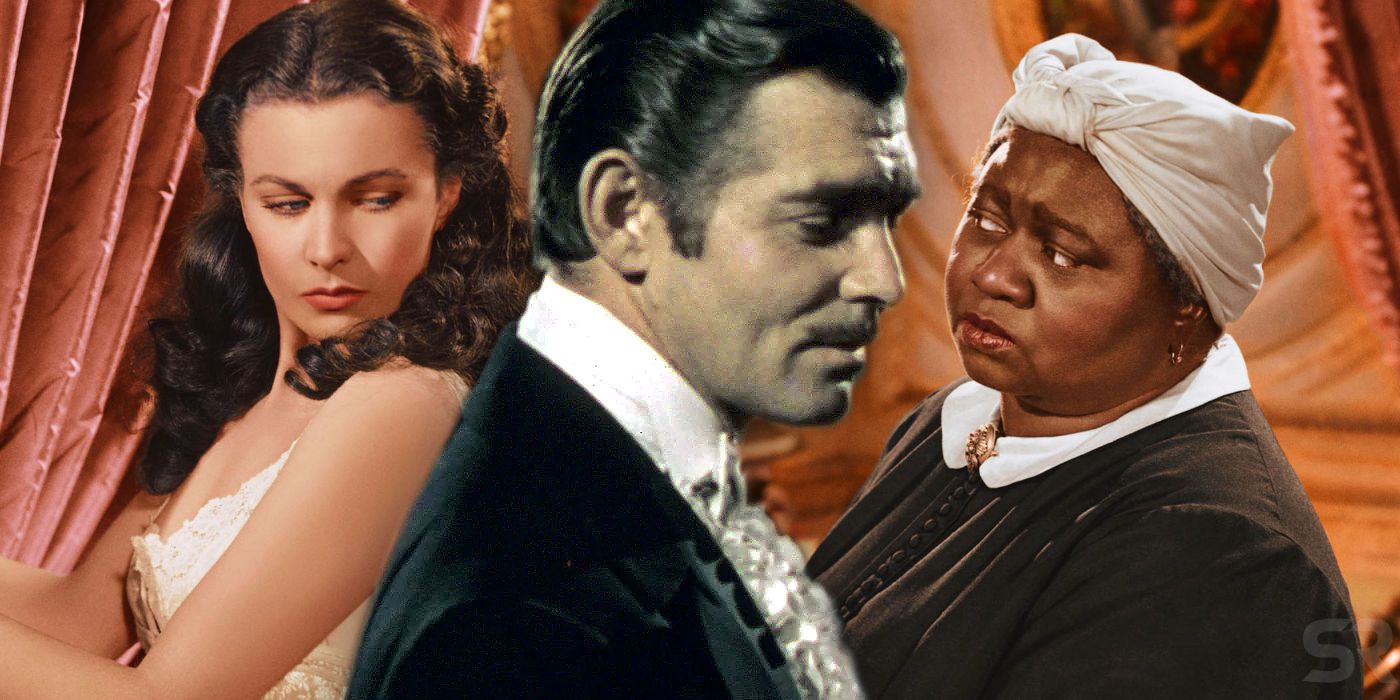
Gone With The Wind is a movie that hasn't been treated well by time. In recent times, the 1939 film has been called to be removed from streaming services due to its depiction of certain topics. For one, the movie underplays the issue of slavery. It depicts slaves as more of house maids than anything. Mammy, for instance, is depicted more as a servant and mentor to Scarlett than a slave. Prissy is depicted as a crybaby who doesn't do what she's supposed to and goes relatively unpunished. There's nothing inherently wrong with these depictions, because in truth it is how some slaves were treated at the time. The problem with these depictions is this is how slavery as a whole is depicted in the move. It conveniently glosses over the whipping, long hot days of hard labor, unsanitary and overcrowded living spaces, etc. 

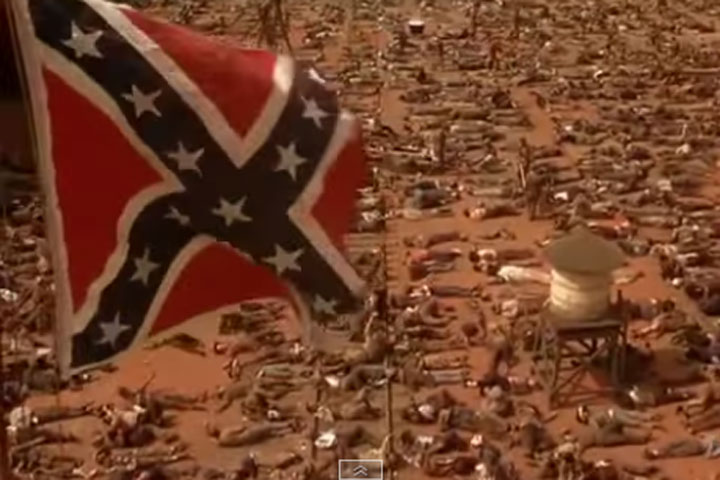
The film also romanticizes the confederacy. The most obvious way it does this, as mentioned previously, is by downplaying slavery, the entire reason the civil war was fought. But even looking past that, it neglects to mention that slavery is the reason this war is being fought at all, which reinforces the harmful idea that it was not being fought for that reason. Confederates are depicted in a completely sympathetic light while northerners are just the enemy. We rarely see them, only what they left in their wake, being burned villages and wounded/killed soldiers. 

I do like how this movie gives us a glimpse into the southern perspective of the war, and It's good to have that, but I wish the movie actually acknowledged what was really going on. It's historically accurate to depict the confederacy as an area that believed it was fighting for a good cause, how the characters think about the war is accurate. This does not mean the movie has to treat the war this way however, I believe the movie could've had much more impactful messages if it showed the true sinister nature behind the war, and how the characters were ignorant to it. If someone who wasn't knowledgeable in U.S. history were to watch this movie, they could easily see the south as the good guys and the north as the bad guys. That's where this movie faulters in its historical accuracy.


To be completely honest, I did not enjoy this movie that much. What I mentioned previously is an echo of my overall feelings for this movie: it's outdated. I can look at a work of art from its time, but even in 1939 it was widely accepted that the confederacy was not good. Even ignoring all of that, just looking at it as a movie and nothing else, I'm still not a huge fan. I'll admit this isn't the movies fault, but a lot of the plot points felt cliche to me. I'm sure at the time these were pretty revolutionary ideas but nowadays, I've seen this type of story again and again. I also found a lot of the characters to be kind of unlikeable. I am glad I watched this movie, and I do appreciate it from a historical perspective, especially looking at the civil war from a different perspective, but truthfully I just couldn't connect with it that much.


Sources:

https://www.britannica.com/topic/Gone-with-the-Wind-film-by-Fleming

https://www.smithsonianmag.com/arts-culture/how-gone-wind-took-nation-storm-feeding-its-southern-sensibilities-180953617/

https://time.com/5852362/gone-with-the-wind-film-history/

https://movieweb.com/why-gone-with-the-wind-still-important/

https://www.nytimes.com/2020/06/10/movies/gone-with-the-wind-controversy.html?smid=url-share

images:

https://m.media-amazon.com/images/M/MV5BYjUyZWZkM2UtMzYxYy00ZmQ3LWFmZTQtOGE2YjBkNjA3YWZlXkEyXkFqcGdeQXVyNzkwMjQ5NzM@._V1_.jpg

https://globalnews.ca/wp-content/uploads/2015/06/gwtw2.jpg?quality=85&strip=all

https://static1.srcdn.com/wordpress/wp-content/uploads/2020/06/Gone-With-the-Wind.jpg

Thursday, October 5, 2023

Mock Trial + EOTO Reaction

 Mock Trial Reaction


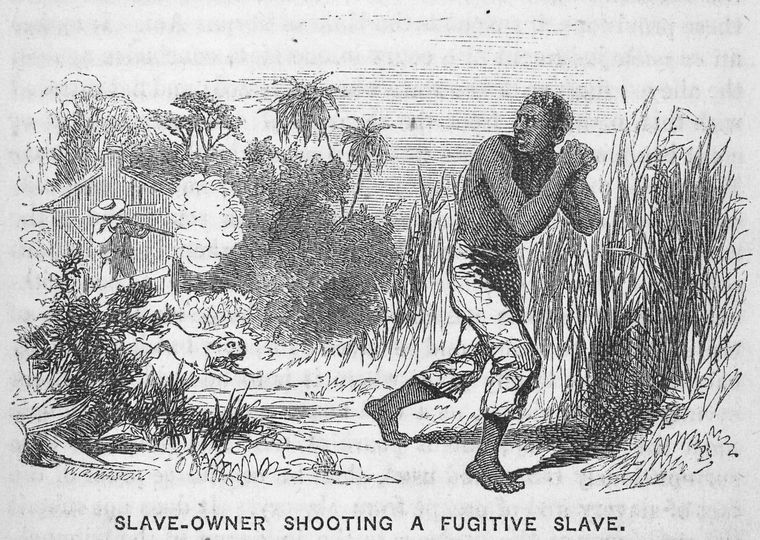
The mock trial was on State v Mann. John Mann shot a slave he rented after she tried to run away due to John abusing her. John was found guilty of assault and battery and was fined five dollars (cwnc.omeka). Adjusted for inflation thats $166.86 in today's money (officialdata.org). Obviously from today's standards we can see this as the gross miscarriage of justice that it is, and our good pal John Mann agrees with us, so he appealed the case to the supreme court. Of course we would wish that John Mann faced jail time while he was just trying to appeal the fine. That's ultimately what this mock trial is about, and both sides had arguments that I found very interesting.

On the state side, seeking to uphold the five dollar fine, the economic and wrong side of history arguments were the most interesting to me. In debates regarding slavery at the time, economic factors were most commonly used as a reason to uphold the institution, but in this case it was used against the institution in a really unique way. The state argued that if slaves are so important to the economy, why are we shooting them and treating them badly? that will just cause productivity to go down. This is a really interesting twist on the economic argument that is very strong. The wrong side of history argument was about how many other countries at the time had already abolished slavery. Many other countries already knew slavery was wrong, so we can't just give them the benefit of time. The U.S. was falling behind other countries and needed to progress, I really liked this argument.

On John Mann's side, arguing to give Mann his five dollars back there were a few arguments that stood out to me. One argument was that if Lydia, the slave, ran away, she could've become dangerous. John was simply protecting society by shooting her. Obviously this is pretty racist and doesn't have much basis, but for an argument of the time it worked really well. This really was what people believed at the time, so I think it captured the feelings of the era well. Another argument I found interesting was that Lydia was committing the crime of running away, why should John Mann be punished for holding her accountable? This was a really interesting way to put it and this argument stuck with me.

EOTO Reaction


The EOTO had two parts: Events that advanced slavery, and The Founding Era (De Jure Slavery).

For events that advanced slavery there were several new things that I learned. From the Missouri compromise, I learned that part of the reason congress compromised it was because they didn't want to take an official stance on slavery. Goes to show really how divisive the issue was, also reminds me of modern similarly spineless politicians. Another interesting thing I learned was the during the election of 1860, Lincoln wasn't included in the ballots of ten southern states, but he still won. I couldn't possibly imagine that happening today, multiple states just not including a major candidate on their ballot. It's shocking how bad the political landscape got at this time.

For De Jure Slavery, there was also a few new things I learned. One thing that shocked me is how many slaves were freed by the underground railroad. I didn't know how big it was but apparently tens of thousands of slaves were freed by it. Another interesting fact I learned was that part of the reason Lincoln won, was that the democratic party was split between two candidates. Lastly, I learned about the American Anti-Slavery Society. I'd actually never been taught of this before, but it was the largest abolitionist organization in the United States and featured such names as William Lloyd Garrison, Arthur Tappan, and Frederick Douglass. Agents of the organization would travel the country and disturb pro slavery movements. I think this is really cool, I wish I learned about it earlier.


Sources:

https://education.nationalgeographic.org/resource/underground-railroad/

Images Cited:

https://s3.amazonaws.com/cdn.bunkhistory.org/derivatives/rectangle_large/images/2019-09/$2y$10$GQH0RGQAcNFWXK2UUzCu9OTQLA1C0AXNEkAmWPy.eDEzi3OAH2W/SCOTUS.AP_88092711770.jpg

https://nmaahc.si.edu/sites/default/files/styles/max_1300x1300/public/2022-12/2012_160_6_001.jpg?itok=-mYgn_x-

State v Mann

State v Mann Post


I was part of the State v Mann mock trial and I was assigned to defend John Mann and to revoke his fine. Among my group, I was doing the religious argument, here was my piece I read from during the mock trial:

According to the word of god, John Mann was justified in what he did. John Mann’s punishments against Lydia were are justified according to Exodus 21:20-21: “Anyone who beats their male or female slave with a rod must be punished if the slave dies directly as a result, but they are not to be punished if the slave recovers after a day or two, since the slave is their property.” John whipped Lydia as punishment and Lydia attempted to run away as a result, this is not allowed by the Bible according to Colossians 3:22: “Slaves, obey your earthly masters in everything; and do it, not only when their eye is on you and to curry their favor, but with sincerity of heart and reverence for the Lord.” From these two bible verses we know that John Mann was justified in his actions to beat Lydia and she was not justified to run away.

Because John shot Lydia, one might attempt to argue that John should be punished according to Exodus 21:20 since she couldn’t have recovered after a day or two. However, Lydia’s fate is unknown so we cannot be certain if she actually did survive or not. It is completely possible that she did survive by being nurtured back to health by fugitive slaves in the surrounding swampland. Because of this fact, we cannot say for a fact if Lydia did die at John Mann’s hand. In order to give John Mann a fair trial in accordance with the due process clause of the fifth amendment, we cannot prosecute him because we cannot prove beyond a reasonable doubt that he did anything wrong.

Sources:

https://northcarolinahistory.org/encyclopedia/state-v-mann/

https://www.aaihs.org/state-v-mann-lydias-journey/

https://www.law.cornell.edu/wex/fifth_amendment#:~:text=The%20Fifth%20Amendment%20of%20the,public%20danger%3B%20nor%20shall%20any

https://www.investopedia.com/terms/d/due-process.asp#:~:text=Due%20process%20is%20a%20requirement,both%20civil%20and%20criminal%20matters.

Bible verses:

https://www.biblegateway.com/passage/?search=Exodus%2021%3A20-21&version=NIV

https://www.biblegateway.com/passage/?search=Colossians%203%3A22&version=NIV


Obviously I don't really agree with what I wrote here. For one its disgusting to suggest that Lydia is somehow in the wrong for this, and John was completely justified. Unfortunately this is something that could be argued at the time and people could actually agree with it instead of seeing it for the obvious morally horrible argument that it is, and ultimately that's what I was going for, that's what I had to go for as I was assigned to be on John Mann's side. It is interesting how the bible seems to have two specific verses that fit perfectly with this case, I specifically remembered them from the bible team challenge. 


Overall I'm happy with the argument I made from a historical context, I think it's accurate to the time. One big mistake I made though was that my argument included some misinformation: 

"However, Lydia’s fate is unknown so we cannot be certain if she actually did survive or not. It is completely possible that she did survive by being nurtured back to health by fugitive slaves in the surrounding swampland."  

I got it from this quote: 

"We don’t know how badly she was wounded. (The guardianship account for 1829 shows no medical expense.) Perhaps she found cover in the nearby swamps, where maroons–fugitive slaves who had long populated that uninhabitable land–would have helped her evade capture." (aaihs.org)

We actually do know that she didn't die, thanks to Mr. Smith for informing me of that. This happened for two reasons: One and most obviously is that I only used one source for this information, I should've used multiple sources to ensure my information was accurate. Two is that I misinterpreted the quote from the website. I took "We don't know how badly she was wounded," as we didn't know if she died or not, which was a hasty generalization on my part. Going forward I need to be more aware of misinformation so I can avoid it. I'll be sure to read my sources carefully and confirm with multiple sources next time.

Images cited:


Mock Trial #4 Reax

  Mock Trial #4 Reax The justice giving the final summary at the trial This week's mock trial was on the case of Board of Regents vs. Ba...